An hour of light once cost a day's work
The economist William Nordhaus priced light in hours of work: from 41.5 hours per thousand lumen-hours for a Babylonian to a fraction of a second today. Put in your wage and your tariff and see where the lamp over your desk stands on that ladder.
The price of light
Enter your hourly wage, your price per kilowatt-hour and your bulb's lumens and watts: the calculator shows how many seconds of work an hour of its light costs and where that rung sits on Nordhaus's ladder. Without scripts, the ladder below shows the default values.
An example: the US median wage and average price per kWh. Put in your own numbers, in any currency.
One hour of your lamp costs
0.25 s of your work
1,000 lumen-hours: 0.32 s of work, 470,000 times cheaper than for a Babylonian in 1750 BC.
Your lamp gives 88.9 lm/W. A tungsten lamp of 1920 gave 11.8, a compact fluorescent of 1992 68.3, the Babylonian oil lamp 0.06.
The bulb itself ($2.50 over 25,000 hours) is 6 % of that.
The ladder of prices: hours of work per 1,000 lumen-hours
- 1750 BC · Babylon: sesame-oil lamp 0.06 lm/W41.5 h
- 1800 · Tallow candle 0.08 lm/W5.37 h
- 1815–45 · Whale-oil lamp 0.13 lm/W4.90 h
- 1875–85 · Kerosene lamp 0.16 lm/W14 min
- 1883 · Edison's carbon-filament lamp 2.6 lm/W45 min
- 1900 · Carbon-filament lamp 3.7 lm/W13 min
- 1920 · Tungsten-filament lamp 11.8 lm/W49 s
- 1950 · Tungsten-filament lamp 11.9 lm/W6.8 s
- 1992 · Compact fluorescent lamp 68.3 lm/W0.43 s
- today · Your lamp: 800 lm, 9 W 88.9 lm/W0.32 s
The eras follow Nordhaus's table 1.6 (1996): hours of work at the wage of the day per 1,000 lumen-hours. He asks for considerable caution with the earliest figures; the Babylonian one rests on his own sesame-oil lamp experiment. Today: (watts ÷ lumens) × price per kWh ÷ wage, plus the bulb price spread over its rated life.
An hour of light once cost a day's work
In 1800 an hour of the light an ordinary 800-lumen bulb gives, bought as spermaceti candles, cost an American farm worker almost ten hours of work, a whole working day; a Babylonian labourer burning sesame oil would have paid more than thirty. Today the same hour costs a quarter of a second of work, less than it takes to reach the switch.
William Nordhaus, professor of economics at Yale, asked a plain question in 1996: how much work has light cost through the ages? He bought a terracotta lamp sold as Roman, filled it with cold-pressed sesame oil and measured it with an illuminance meter: a quarter of a cup burned for 17 hours and gave 28.6 lumen-hours. He gathered the prices of candles, whale oil, town gas, kerosene and electricity and the wages of labourers and workers, and divided one by the other. The result is the labour price of light: hours of work per thousand lumen-hours. His estimate: an hour's work today buys about 350,000 times as much illumination as in early Babylonia, where a common labourer earned about a shekel a month, roughly the price of ten litres of sesame oil.
A lumen measures the flow of light: a wax candle emits about 13 lumens, a hundred-watt filament bulb about 1,200. A lumen-hour is one lumen for an hour. Counting in lumen-hours rather than in candles and watts is what puts a Babylonian temple lamp and the lamp over your desk on the same scale.
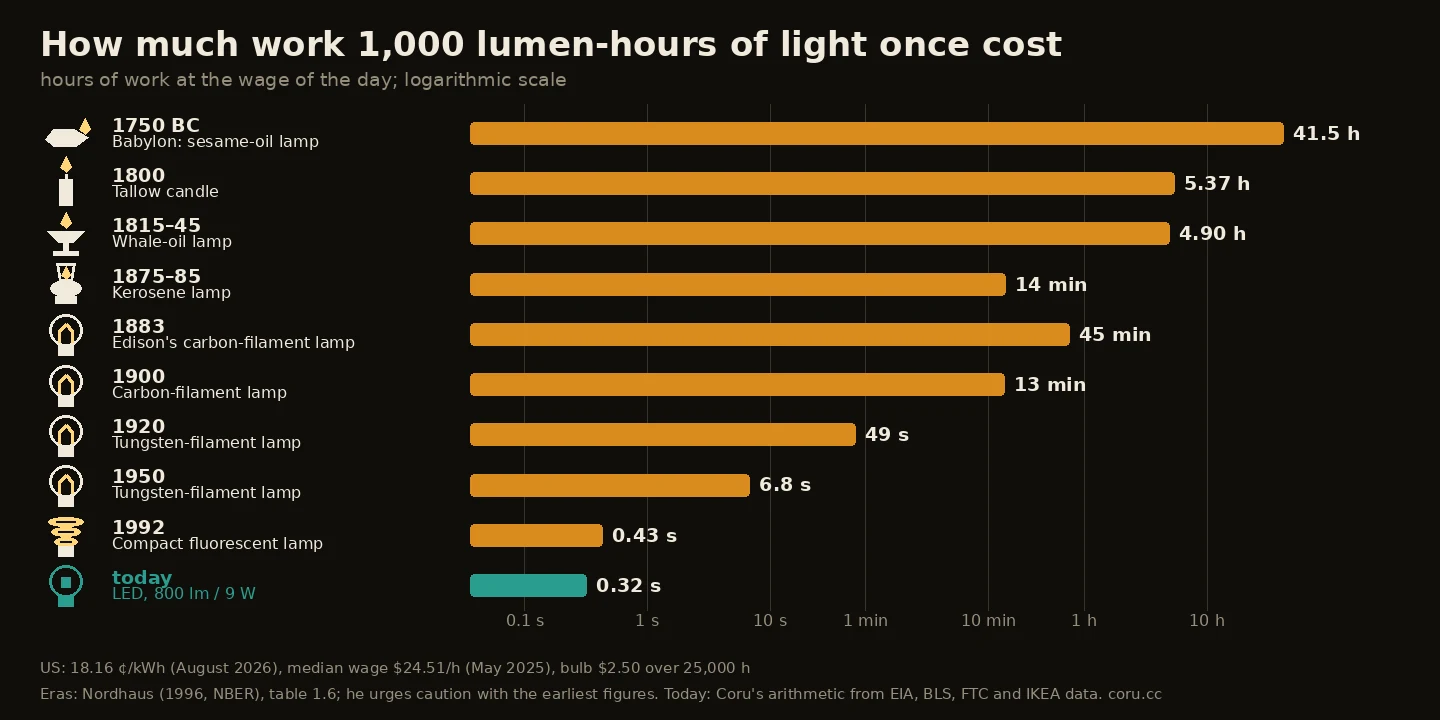
The ladder of prices
In Nordhaus's table 1.6 a thousand lumen-hours cost 5.37 hours of work with tallow candles in 1800 and 4.90 hours with a whale-oil lamp of 1815–45. The kerosene lamp of 1875–85 brought the price down to 0.2253 hours, about 14 minutes. Edison's carbon lamp of 1883 cost 45 minutes; Edison, Nordhaus notes, priced his first electric light to match gaslight. The carbon filament of 1900 took 13 minutes, the filament lamp of 1920 49 seconds and that of 1950 6.8 seconds, the compact fluorescent bulb of 1992 0.43 seconds. Nordhaus warns that the figures for the earliest periods should be regarded with considerable caution, and the Babylonian one rests on his own experiment; the most reliable measurements, he writes, are Silliman's of 1855 and those of the modern era.
Behind the ladder stands efficacy, the light per watt of fuel or electricity burned. In Nordhaus's table 1.3 the Babylonian lamp gives 0.06 lumens per watt, a tallow candle 0.08, a kerosene lamp of 1875–85 0.16, Edison's carbon lamp 2.6, the tungsten filament of 1920 11.8 and the compact fluorescent of 1992 68.3. Today an LED bulb gives the 800 lumens of an old 60-watt bulb from about 9 watts, by the Federal Trade Commission's guide: 89 lumens per watt.
Nordhaus also counted a year of light: one hundred-watt bulb burning three hours each night gives 1.5 million lumen-hours. By his table that much light cost about 8,000 hours of work in the tallow candles of 1800 and about 340 hours with a kerosene lamp of 1875–85. With a compact fluorescent bulb, he writes, it needs twenty-two kilowatt-hours, about ten minutes' work by the average worker. With a 9-watt LED it is 17 kilowatt-hours: seven and a half minutes at today's American price and median wage.
How we count today
The arithmetic follows Nordhaus's definition: hours of work per thousand lumen-hours = (watts ÷ lumens) × price per kilowatt-hour ÷ hourly wage. To the electricity we add the price of the bulb spread over its rated life, when the maker states both. The calculator at the top of the page does exactly this and also tells you how many seconds of work one hour of your lamp costs.
It opens with American numbers: the median wage of $24.51 an hour (Bureau of Labor Statistics, May 2025), the average residential price of 18.16 cents per kilowatt-hour (Energy Information Administration, August 2026) and an 800-lumen bulb at 9 watts. A thousand lumen-hours then take 11.25 watt-hours: 0.2 cents, 0.30 seconds of work. Add a bulb at IKEA's price, $4.99 for a pair of 800-lumen SOLHETTA bulbs rated for 25,000 hours, and it is 0.32 seconds, about 470,000 times cheaper than for the Babylonian. European household prices are higher, by Eurostat €0.2832 per kilowatt-hour on average in the EU in the first half of 2026, €0.3871 in Ireland and €0.3618 in Germany, but the order of magnitude is the same.
Your own currency works the same way: the answer is in hours and seconds of work, so the currency only labels the fields and nothing is converted. The numbers you type never leave your browser: the calculator stores nothing and sends nothing.
What this means for your flat
One evening, four hours of a single 9-watt LED bulb, is 36 watt-hours: 0.65 cents at the American price, about one second of work. A year of such evenings is 13 kilowatt-hours, about $2.40, under six minutes of work. In Ireland, where Eurostat found the EU's highest household price, the evening costs 1.4 euro cents.
That is why a bright bulb is no longer a decision, just a choice. A second bulb in the room adds a second of work an evening; a 1,600-lumen bulb at the same efficacy costs the same two seconds. Not so long ago the choice was real: by Nordhaus's table the same evening of 800 lumens, 3,200 lumen-hours, cost 42 minutes of work under the carbon filaments of 1900 and 17 hours under the tallow candles of 1800.
Efficacy is still climbing. The European energy label for light sources is set in lumens per watt: class F runs from 85 to 110, class A starts at 210. An 800-lumen bulb at 9 watts, 89 lumens per watt, is class F; IKEA's SOLHETTA gives the same 800 lumens from 5 watts, 160 lumens per watt, so an hour of its light costs a little more than half as much. The bulb itself barely shows in the bill: $2.50 over 25,000 hours is six per cent of the cost of an hour of light.
Light got so cheap that greenhouses outshine cities
When a thousand lumen-hours cost a third of a second of work, light stops being something anyone saves, and it shows from space. In NASA's night lights of 2024 the brightest point around Närpes, a small Finnish town at 62.5° north that grows most of the country's tomatoes under lamps, shines 96 times brighter than the brightest point of central Helsinki. On the Russian plain a greenhouse complex south-east of Yelets outshines Lipetsk 228 times. Brighter than the greenhouses in that data are only the gas flares of oil fields in Iraq, Venezuela and Iran.
We took those pictures apart on our page about the greenhouses that outshine cities and made a short film from them; the same page counts how much light plants need and what a lamp on a windowsill adds. For a Babylonian, one evening under the lamp over your desk would have cost more than 130 hours of work. We pay a second and do not notice it at the switch.
Sources & further reading
- Nordhaus W. D., Do Real-Output and Real-Wage Measures Capture Reality? The History of Lighting Suggests Not, NBER 1996, chapter c6064 (PDF): tables 1.3 and 1.6, appendix
- NBER: chapter c6064 page
- EIA, Electric Power Monthly, table 5.6.A: average price of electricity to ultimate customers, residential, August 2026
- BLS, Occupational Employment and Wages, May 2025, table 1: median hourly wage, all occupations
- Eurostat: electricity price statistics, household consumers, first half of 2026
- US Federal Trade Commission: shopping for light bulbs, lumens and watts
- Commission Delegated Regulation (EU) 2019/2015: energy labelling of light sources, efficiency classes
- IKEA SOLHETTA LED bulb E26 800 lumen, dimmable: 5 W, 25,000 hours, $4.99 for two
- Coru: the greenhouses that outshine cities
- Coru Short on YouTube: night lights